


Prefabrication and modular construction can introduce efficiency, safety and quality in every project phase. Despite these advantages, the challenge of ensuring that factory-built modules fit when they reach the site still exists. A single misalignment between a concrete slab and a prefabricated wall can cause delays, rework, and change orders that negatively impact productivity.
Below, we explore how using Trimble scanning for prefabrication and modular construction, improves productivity by; Eliminating rework, help you keep 3D model precision aligned with real world site conditions, improving accuracy, saving time, and controlling expense.
The Challenge of Aligning Prefabrication With Real-World Conditions
Prefabrication and modular construction offer a powerful path to efficiency while also introducing unique risks. When parts are built off-site, they must fit into real-world conditions. Real world conditions are constantly changing and introduce a level of error from field to office interpretation. Scanning, for prefabrication removes potential errors with accurate, measurable, real-world scans using current site conditions. Eliminating, return visits, rework, and logistical bottlenecks.
Some of the most common challenges that disrupt modular or prefabricated projects include:
- Uneven foundations or slabs: Even minor measurement differences can prevent a module from fitting where it is supposed to go. Resolving these issues before the concrete can harden, eliminates expensive, time consuming, invasive re-work. If the concrete is pre-tensioned, you can expect even further delays and growing costs to repair.
- Inaccurate or incomplete as-built records: Design teams work from assumptions instead of facts when site data is outdated. The data they are using must be accurate and complete. Forgetting to take even a single measurement requires a re-visit. Scanning allows anyone to gather as-built data without the knowledge required traditionally for a fabrication scope of work. This increases productivity/efficiency and decreases re-work by offering complete data points without requiring a specialist in fabrication to come on site and measure off existing conditions.
- Misaligned embeds or anchor bolts: These small inaccuracies compound when modules must fit precisely together. Anchor bolts and embed locations often require a MEWP or mobile platform to access and measure. A premium configured X9 scanner, can scan up to 150M. Eliminating the need for certified MEWP operators, spotters, and permitting required to gather these measurements.
- Limited visibility across teams: Factory crews, field teams and project managers may operate with different sets of information. Job sites are constantly changing, and that constant change requires the BIM/VDC dept and the Field to be working with data that is accurate and complete. Connect, coupled with a Trimble scanner, gives the office the most accurate and complete data. Allowing the customer to edit scans and export to field instantly. Accurate data and a digital platform to connect the field to the office, eliminates re-work due to miscommunication, downtime due to logistical errors, and increases productivity across all scopes of work.
How 3D Laser Scanning Bridges the Gap Between Factory and Field
3D laser scanning captures millions of measurement points in seconds, turning physical environments into highly detailed digital twins. Each scan provides a true-to-scale, data-rich picture of every surface, structure and object.
For prefabrication and modular construction, every step of the process, from design to delivery, is informed with verified, real-world data rather than assumptions. Teams can verify dimensions and confirm that prefabricated components align exactly with on-site conditions.
For example, a team might be working on a project assembling mechanical modules in a factory hundreds of miles away. With 3D scanning there is no mismeasured areas, missing required measurements, return trips to pull measurements, etc. The team can capture precise measurements of both the modules and the installation site prior to even ordering materials. Scanning ensures that all data points are captured and can be referenced for the length of the pre-fab with accuracy and consistency.
Applying Trimble Scanning in Modular Construction
Modern scanning solutions, like the Trimble X9, make high-precision reality capture accessible to construction teams without slowing down workflows or requiring specialized technicians.
Designed specifically for the demands of construction environments, the Trimble X9 combines speed, accuracy and ease of use in one compact system. With auto-calibration, tablet-based controls and rapid scan times, it eliminates much of the complexity historically associated with laser scanning.
Since the Trimble X9 doesn’t require manual calibration, crews can set it up and start scanning immediately, which can be ideal for tight construction schedules. The scanner’s ability to capture millions of points per second means you can digitize even large modules in minutes.
How Trimble Scanning Connects to BIM
Trimble scanning is designed to integrate directly with Building Information Modeling (BIM) workflows. The point cloud aligns with the digital model so teams can compare actual field or shop conditions to the design. This process ensures that everyone on the team works with the same source of information.
Benefits of Trimble X9 3D Scanning for Prefabrication and Modular Construction
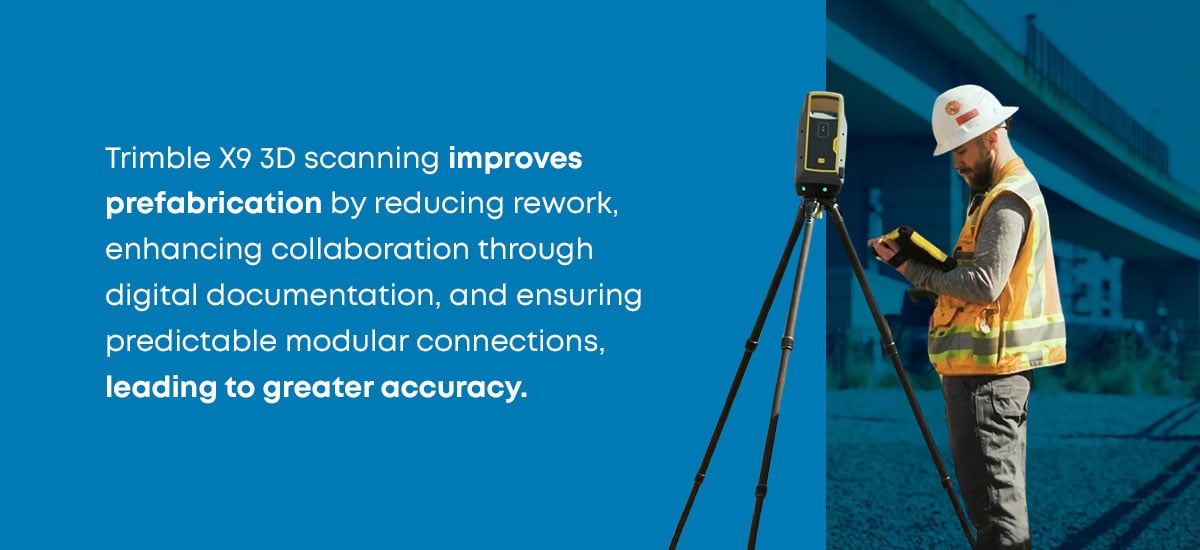
By validating each step before physical assembly, scanning can help improve accuracy and build trust across the project team. Trimble scanning directly addresses multiple challenges in a few key areas:
- Reduced rework: Verifying accuracy in the factory and on-site minimizes costly adjustments.
- Enhanced collaboration: Digital documentation allows teams across locations to review, approve and align quickly.
- Predictable outcomes: Accurate scans ensure every module connects precisely as designed.
Ensuring Quality Control in the Fabrication Factory
The factory is where precision begins. Prefabricated panels, mechanical racks or concrete segments must match digital design models.
Verifying Component Accuracy Against Digital Models
Before a module leaves the factory, it can be scanned to create a detailed 3D point cloud. This scan is overlaid with the BIM model to compare as-designed versus as-built conditions. Even minor discrepancies, such as a misplaced opening or slightly skewed connection, are visible instantly.
Catching these issues before shipment prevents rework on-site, where corrections can be time-consuming and costly. Trimble scanners give the ability to check, adjust, and confirm accuracy of pre-fab sections against 3D models prior to delivery. Ensuring quality, consistency and repeatability.
Documenting As-Built Conditions Pre-Shipment
Once fabrication is complete, contractors can record a final scan. This creates a verified digital record of the finished module before it leaves the floor.
Documenting serves the following purposes:
- Quality assurance: Confirms compliance with design specifications.
- Accountability: Establishes a record for warranty and handover.
- Collaboration: Allows project managers and engineers to review the data remotely before delivering components.
Preparing the Site
Once the factory work is complete, attention turns to the field. A precise, ready site is essential for smooth modular assembly.
Using construction laser scanning, crews can capture the as-built conditions of the foundation, anchor bolts and other essential components. The scan confirms that every element is positioned correctly before modules arrive.
For example, a concrete contractor can scan the foundation slab to confirm that anchor points align exactly with the module’s connection layout. If an issue appears, it can be corrected before delivery.
This proactive approach eliminates last-minute fixes and ensures installation crews can assemble modules immediately upon arrival, rather than spending hours troubleshooting misalignments. The result is faster setup, predictable scheduling and a smoother workflow from factory to field with more uptime and less downtime.
Streamlining the Final Assembly and Integration
When the prefabricated modules reach the site, precision becomes nonnegotiable. At this stage, 3D scanning ensures that everything aligns, connects and integrates exactly as planned. With an accurate model and an accurate scan of the site conditions, final assembly and integration can be done without the standard field fitment hurdles of the past.
From Point Cloud Data to Actionable Insights
Each scan generates a detailed point cloud, which can be processed through Trimble RealWorks to create intelligent, data-rich 3D models. These models are compared against the original BIM design to verify dimensions and identify deviations. This is useful for detecting potential clashes between systems, like ensuring that a prefabricated mechanical rack aligns properly with on-site plumbing and electrical components. Since the entire process is digital, teams can perform these checks without disrupting field operations, making coordination faster and more reliable.
Simulating Module Integration Before the Crane Arrives
Once the factory and field scans are complete, the two datasets can be merged to simulate the entire assembly virtually. In this simulation, teams can visualize how each module will connect, align and interface with the surrounding structures. If misalignments are detected, adjustments can be made in the digital model proactively rather than reactively on the site, saving significant time and labor costs due to downtime.
Scanning on Site: Best Practices
One concern about scanning is that it may take too much time. Trimble scanning can be built into existing workflows, supporting progress. The key is to plan each scan with clear goals and simple procedures so the data adds value immediately.
Best practices for efficient scanning include:
- Plan ahead: Decide which conditions/sections need to be verified so the scan is focused and effective.
- Use control: Use job site control to align scanner and tie scans into project control and ensure accurate registration. Using control will align scans to the model for easier overlaying and comparison.
- Capture once with purpose: A single well-positioned scan that covers the area completely is more efficient than repeating the process multiple times. Schedule your scanning to take place in conjunction with other trades to ensure you are maximizing the area and time for scanning.
- Coordinate the data flow: Establish a clear path from scan collection to model review, so results reach designers and field crews without delay. Utilize Trimble Connect to share files between office and field. Streamlining communication to ensure that the data being used is accurate, and current with job site functions.
Take the Next Step With BuildingPoint SouthEast
Prefabrication and modular construction help contractors meet today’s challenges of tighter schedules, labor shortages and budget constraints. However, success depends on accurate alignment between shop-built assemblies and real site conditions. Trimble scanning provides that alignment, supporting quality control, site verification and seamless installation.
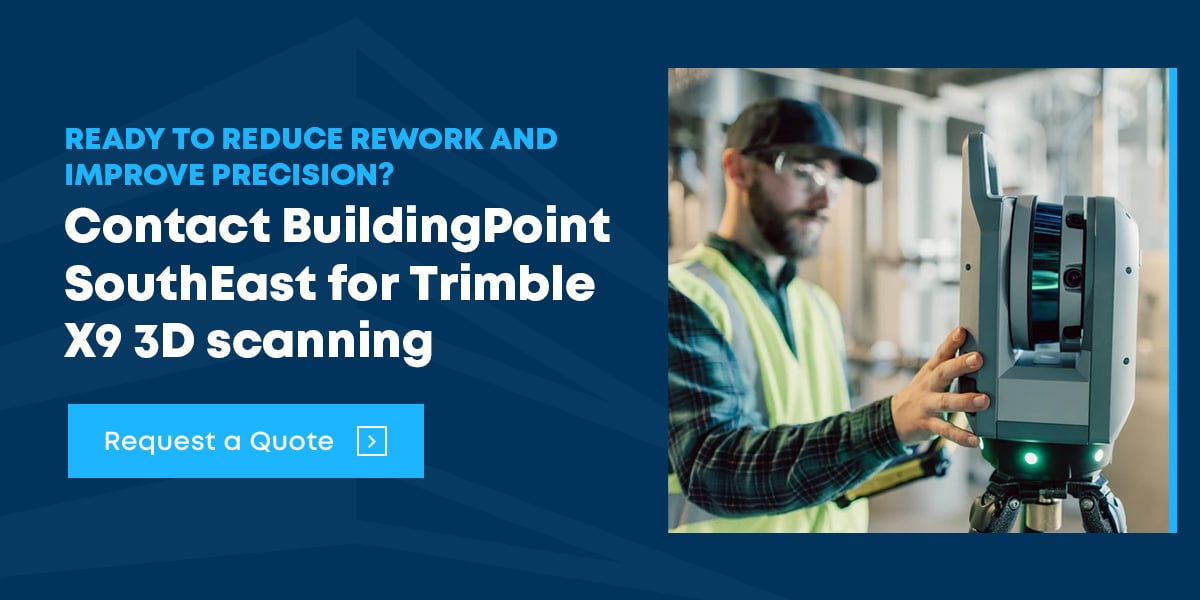
BuildingPoint SouthEast delivers Trimble X9 3D laser scanners and integrated software solutions that streamline your workflows. Backed by our expert local trainings and on-site support, we help you eliminate rework, boost productivity, and achieve unmatched precision. Ready to take your projects to the next level? Contact us today so you can experience a more efficient, streamlined, and profitable job site tomorrow.